The Lana Clinic, Osaka: our visit, the treatment and what research says
글 Natali Ardianto · 업데이트
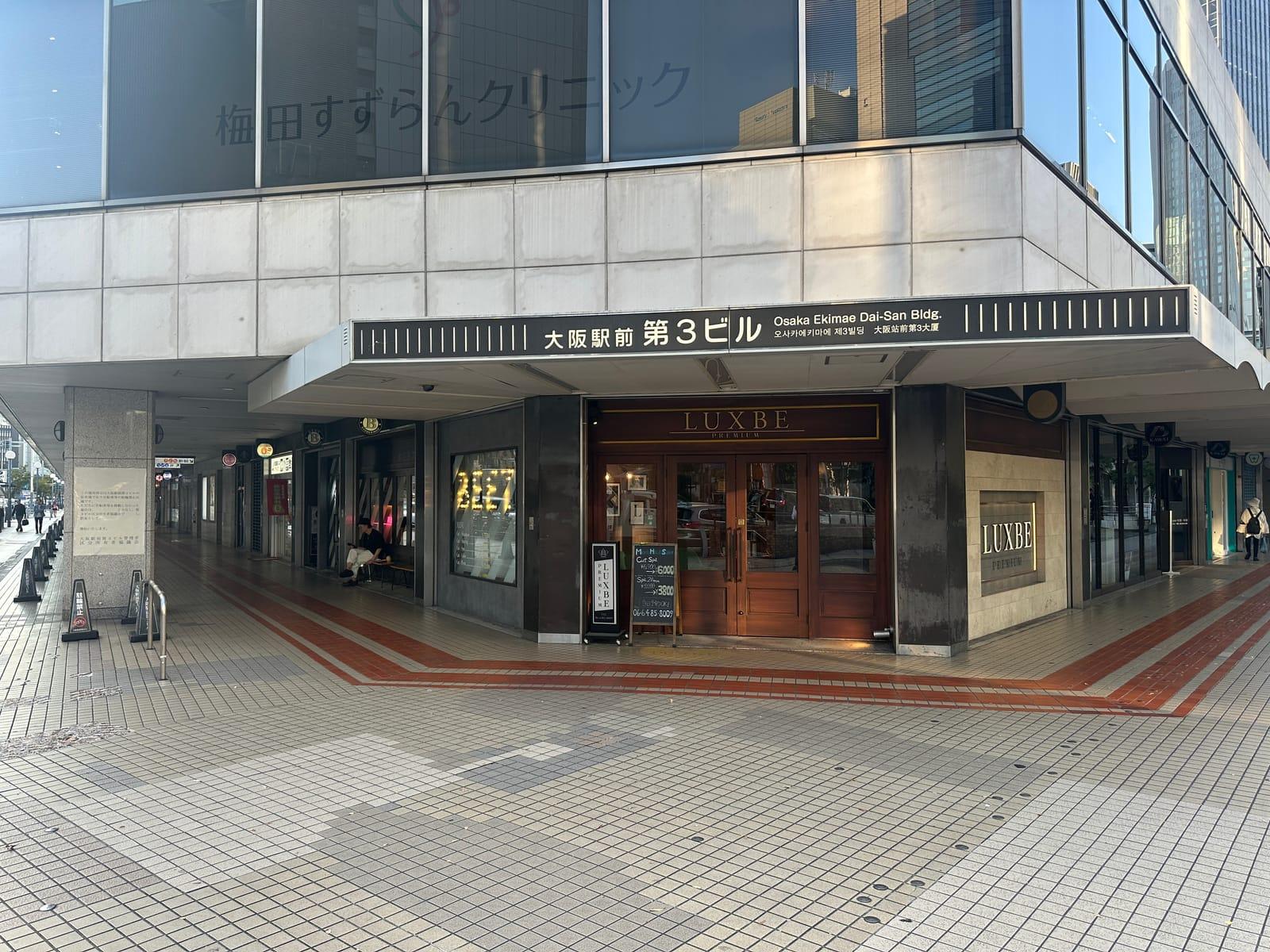
The Lana Clinic is a small aesthetic dermatology clinic on the 18th floor of the Osaka Ekimae No. 3 Building in Umeda, five minutes on foot from JR Osaka Station.[1] My wife Nuniek and I spent an afternoon there in October 2026, at the start of two weeks of travelling, and had a treatment built around stem cell culture supernatant.[2]
We loved it. This page is the long version: what the visit was like, what the treatment is, what research says about it, what things cost, and how to fit a visit into a trip to Osaka.
The clinic at a glance
| Name | The Lana Clinic (ラナクリニック大阪梅田) |
|---|---|
| What it is | An aesthetic dermatology clinic in the middle of Umeda.[1] |
| Address | Osaka Ekimae No. 3 Building, 18th floor, unit 10, 1-1-3 Umeda, Kita-ku, Osaka 530-0001[1] |
| Nearest stations | Kitashinchi (JR Tozai line) 2 minutes; Nishi-Umeda (Yotsubashi line) 3 minutes; JR Osaka, Higashi-Umeda and Hanshin Osaka-Umeda 5 minutes; Hankyu Osaka-Umeda 10 minutes. The building connects to the underground walkways.[1] |
| Hours | 10:00 to 19:00. Reception 10:00 to 13:00 and 14:00 to 18:45.[1] |
| Closed | Mondays, public holidays, the new year period and some other days, posted on the clinic's news page.[1] |
| Booking | Register and book on the clinic's booking page, lana-clinic.b4a.clinic, which is in Japanese. See "How to book" below. |
| Fees | First visit ¥2,200, return visit ¥1,100, tax included.[1] |
| Payment | Cash, or a credit card in a single payment.[1] |
Times and prices are as the clinic's website showed them on 15 November 2026.
Why we started our trip there
Nuniek and I are in our forties. A friend who had been to the clinic described the treatment to us as feeling like "a brand new battery for your body". We were curious, we were going to be in Osaka anyway, and the clinic is in Umeda, where most trips to Osaka begin whether you plan it or not.
It also suited the shape of a trip. A day with one appointment, a short walk and an early dinner is a gentler start than a day of ten sights. That part I would recommend to anyone.
What the visit was like
The building is an office tower with shops and restaurants on its lower floors. You take the lift to 18. The clinic is quiet and pale green, with its name in metal letters on the wall and a view over the roofs of Umeda from the treatment room.
We were seen as a couple, in a private room, and did not meet another guest the whole afternoon.[2] It felt less like a clinic and more like a private lounge. It began with a warm consultation about the treatment and what would happen. Then came three steps.[2]
- A skin treatment the clinic calls C-Opera. It uses electroporation, which helps a serum pass into the skin with small electric pulses and no needles. The clinic lists the serum's base as stem cell extract, growth factors, glutathione and hyaluronic acid.[1]
- A drip of stem cell culture supernatant into a vein in the arm. You sit back in a reclining chair by the window for this.
- The same kind of supernatant as a fine mist, breathed in through the nose from a small nebuliser, in the same chair.
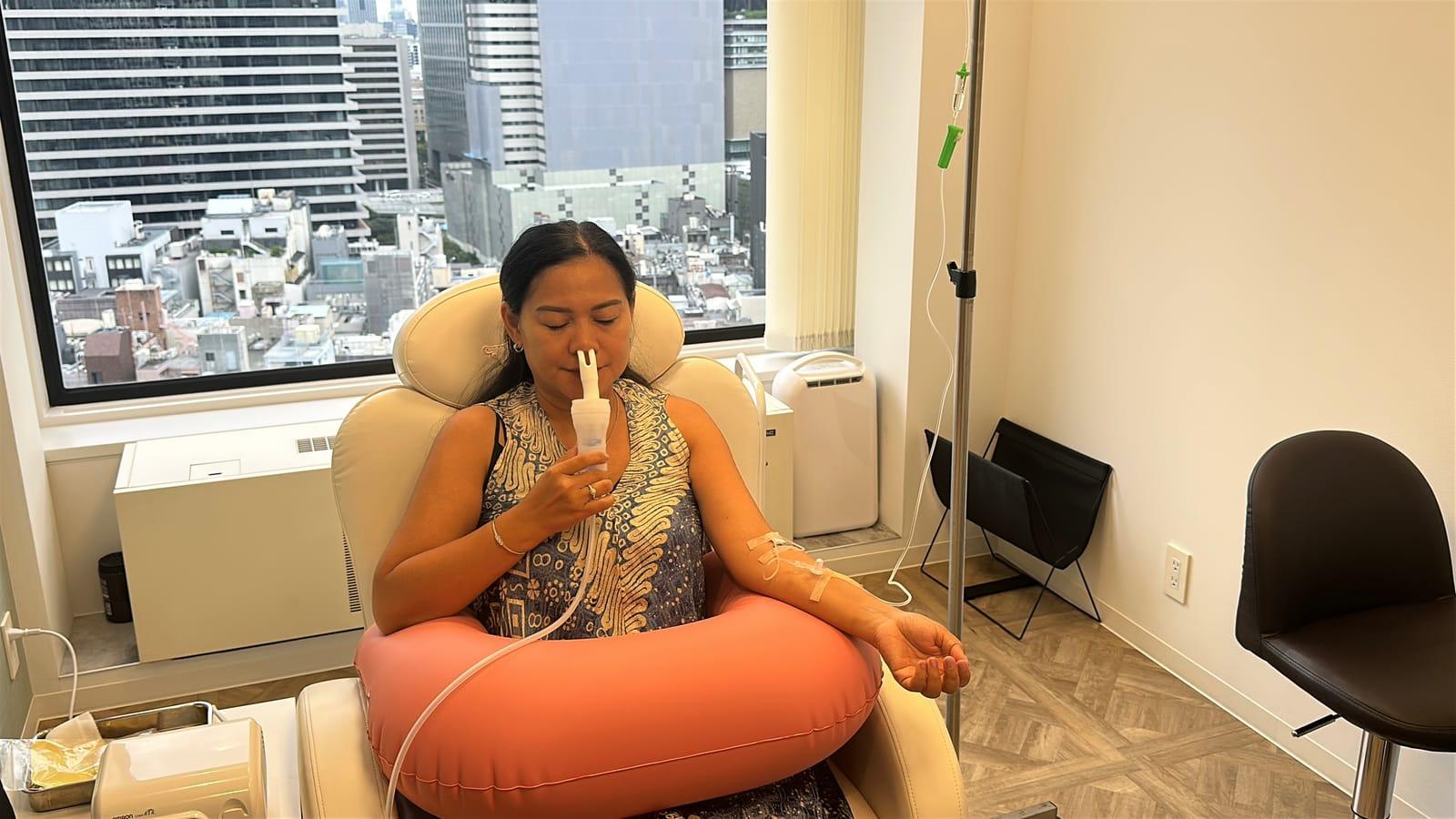
It was restful from start to finish: a comfortable chair, a view and nothing to do. Afterwards the staff talked us through skincare and sent us off with a generous bag of gifts.[2]
The product used for our drip was Stemsup, made in Japan from the dental pulp of baby teeth given by healthy Japanese donors, with every lot safety tested.[2]
What stem cell culture supernatant is
To grow stem cells in a laboratory you keep them in a liquid that feeds them. As they grow, the cells release what they are best known for into that liquid: growth factors, signalling proteins called cytokines, and tiny messenger particles called exosomes. Culture supernatant is that liquid, collected once the cells have been taken out.[3] You receive what the stem cells make, without the cells themselves.
Researchers have a name for this mixture, the secretome, and it is the subject of intense research. A 2021 scientific review describes how it works through "neuroprotective, anti-inflammatory, antiapoptotic, and angiogenic processes": in plainer words, protecting nerve cells, calming inflammation, keeping cells alive and encouraging new blood vessels.[4]
The cells can come from different tissues. The clinic offers supernatant from umbilical cord, dental pulp and fat.[1] Ours came from the dental pulp of baby teeth, a source Japan has made its own: it is the second most used in the country, and researchers describe that as particular to Japan.[3]
Baby teeth turn out to be a remarkable source. In 2003 a team at the US National Institutes of Health found that a shed baby tooth contains stem cells that are "highly proliferative" and able to become several kinds of cell, including nerve cells. They called the teeth "an unexpected unique resource".[5] These are young cells, from a tissue that would otherwise be thrown away.
What research says
This is one of the liveliest areas of regenerative research, and much of it is happening in Japan. We read up on it after we came home, and what we found made us glad we went.
Start with the laboratory. In animal studies, supernatant from baby-tooth stem cells has done some striking things. Given into a vein, it reduced the damage to the heart after an interrupted blood supply and cut inflammation along the way, and it did so more strongly than supernatant from bone marrow or fat cells. The researchers traced part of the effect to a growth factor that the baby-tooth supernatant holds in higher amounts.[6]
In another animal study it "greatly improved" nerve pain, by drawing the body's own anti-inflammatory cells to the injured nerve.[7] And given through the nose, the route we used for part of our session, a preparation from the same supernatant improved movement and helped clear a harmful protein in an animal model of Parkinson's disease.[8] The 2021 review counts neurodegenerative disease, nerve injury, cartilage and bone among the areas where this supernatant "may be effective".[4]
Studies in people have begun, and the early ones are encouraging. In Japan, a doctor gave stem cell culture supernatant, by drip and by inhalation, to 19 patients living with persistent fatigue. Nearly half reported that their symptoms improved after a single dose, some showed signs of reduced inflammation, and no serious side effects were seen. The author describes the findings as offering "new hope and possibilities for treating fatigue".[9] That is the same pair of routes we were given, and tiredness is exactly what our friend's battery line was about.
A second study will interest anyone our age. Sixteen healthy adults aged 46 to 72 followed a 17-week programme that combined two infusions of conditioned media with lifestyle changes and supplements. Their biological age, measured two different ways from blood tests, fell by 2.0 and 2.7 years.[10] It was a small pilot and the infusions were one part of a wider programme, but it is a first sign of where this may go.
More is on the way. Baby-tooth supernatant given by drip is now being studied in patients with ALS, a serious nerve disease.[11] In the wider field of stem cell research, a trial in 148 frail older adults found that those given a stem cell infusion walked about 63 metres further in six minutes, nine months later, than those given a dummy infusion.[12]
These are early days, and that is part of the appeal. The science is young, it is moving quickly, and Osaka is one of the places where you can try it for yourself.
How we felt afterwards
This is the part people ask us about.
We spent the following two weeks in Osaka, Himeji, Sakai and Kyoto. We logged more than 20,000 steps a day and did not feel tired.[2] Our friend was right about the battery.
We were happy with how we felt, and we would do the day again. It is the reason this page exists.
What it costs
These are the clinic's listed prices on 15 November 2026, tax included.[1]
| Item | Listed price |
|---|---|
| First visit fee | ¥2,200 |
| Stem cell culture supernatant by drip or nebuliser | On enquiry |
| Supernatant from dental pulp or fat, as a skin injection (3 ml) | ¥57,000 |
| Supernatant from umbilical cord, as a skin injection (3 ml) | ¥66,000 |
| An exosome product, as a skin injection (5 ml) | ¥49,800 |
| C-Opera skin treatment, full face | ¥7,900 |
| Vitamin and glutathione drips | From ¥3,520 |
The clinic also offers packages that include private use of the clinic and a car.[2] Ask when you book.
Why Umeda makes a good base
If the clinic is your first stop, it makes sense to stay nearby, and Umeda is the most convenient place to stay in Osaka in any case.
- Trains: Osaka Station and the Umeda stations around it put you on direct lines to Kyoto, Kobe, Nara, Himeji and the airport. For day trips it beats Namba.
- Food: the department store basements, the lanes of Kitashinchi, the retro restaurant floor under the Umeda Sky Building, and the Ekimae buildings themselves, whose basements are full of small, cheap and very good places to eat.
- Views: the Umeda Sky Building's open-air deck, and the red Ferris wheel on top of the HEP Five shopping centre.
- Green space: Umekita Park, right beside the station, for a morning walk before the city wakes up.
- Shelter: when it rains or the summer heat is too much, the underground malls let you cross the whole district without going outside.
The Dotonbori lights and the castle are a short subway ride away when you want them.
Getting there
From Kansai Airport, the Haruka express runs to Osaka Station in about an hour.[13] It arrives at underground platforms on the west side of the station, a longer walk from the main concourse than you would expect, so allow ten minutes more than the map suggests. The airport limousine bus to the Umeda hotels takes about the same time and saves you carrying bags through the station.
From Osaka Station, walk south. The Osaka Ekimae buildings are four towers numbered 1 to 4, a few minutes beyond the Hanshin department store, and No. 3 is the tallest. On a wet day you can do the whole walk underground: follow the signs toward Kitashinchi Station, which is two minutes from the building.[1]
Take the lift to the 18th floor. The lower floors are a maze of small restaurants and ticket shops, and worth a look afterwards.
Fitting it into a trip
A session takes two to three hours, so half a day is all you need. That makes it a natural anchor for an easy first day in Osaka. This is how we would plan it.
- Morning: sleep in. Have a late breakfast near your hotel. If you are staying in Umeda, walk through Umekita Park at Grand Green Osaka, the new park on the north side of the station.
- Lunch: the food floors of the Hanshin or Hankyu department stores. They are a short walk from the clinic, and you can eat lightly.
- Afternoon: the clinic.
- Early evening: the Umeda Sky Building for sunset, or Ohatsu Tenjin shrine and the lanes around it, five minutes from the clinic.
- Dinner: Kitashinchi, right next to the building, or the restaurant floors under the Sky Building.
If it rains, almost all of that can be done without going outside. Umeda's underground malls connect the stations, the department stores and the Ekimae buildings.
Where the two weeks took us
With Umeda as a base, the rest of Kansai is close, and this is where the walking added up.
- Osaka itself: the castle and its park, the neon of Dotonbori after dark, the old-fashioned streets of Shinsekai under Tsutenkaku tower, and Kuromon market for lunch on the move. Each is a short subway ride from Umeda.
- Himeji: Japan's finest surviving castle, white on its hill and a World Heritage site. The special rapid train from Osaka Station takes about an hour, and the walk from Himeji Station to the top of the keep and back is a morning's worth of steps on its own.
- Sakai: the quiet city just south of Osaka, known for its knives, its old tram line and its great keyhole-shaped burial mounds, among the largest tombs in the world. It is an easy half day.
- Kyoto: half an hour from Osaka Station by special rapid. Temples, gardens and lanes that reward walking all day.
October suited all of it. The weather was ideal, and there were free festivals and fireworks in the evenings.[2]
Before you book
This is a wellness treatment, something you do for the pleasure of it and for how you hope to feel on your trip. It is not for treating an illness.
If you have cancer or have had it, are pregnant, or take regular medicines, talk to your own doctor first.
- Book ahead. The clinic is small and closed on Mondays, and the first days of a trip fill up quickly.[1]
- The booking page and the clinic's website are in Japanese. A translation app on your phone is enough to get through the form, and it helps on the day too.
- Bring cash or a credit card. Payment is in one go.[1]
- Keep the rest of the day free. You will want to wander Umeda afterwards, not rush for a train.
For everyone else, Umeda is a wonderful place to begin a visit to Osaka, and an afternoon at The Lana Clinic is a wonderful way to begin it.
How to book
The clinic takes registrations and bookings on its own booking page, which is in Japanese. Register, choose a day, and enjoy the start of your trip.
Register and book at The Lana Clinic출처
- [1]The Lana Clinic. Clinic information and price list. lana-clinic.jp. Read 15 November 2026. https://lana-clinic.jp/
- [2]Tirta N. Our VIP anti-aging secret: a couple's stem cell getaway in Osaka. nuniek.com. 10 November 2026. Our own account of the visit. https://nuniek.com/2026/11/our-vip-anti-aging-secret-couples-stem.html
- [3]Fujita M, Hatta T, Ikka T, Onishi T. The urgent need for clear and concise regulations on exosome-based interventions. Stem Cell Reports. 2024;19(11):1517-1519. https://doi.org/10.1016/j.stemcr.2024.09.008
- [4]Bar JK, Lis-Nawara A, Grelewski PG. Dental pulp stem cell-derived secretome and its regenerative potential. International Journal of Molecular Sciences. 2021;22(21):12018. https://doi.org/10.3390/ijms222112018
- [5]Miura M, Gronthos S, Zhao M, Lu B, Fisher LW, Robey PG, Shi S. SHED: stem cells from human exfoliated deciduous teeth. Proceedings of the National Academy of Sciences. 2003;100(10):5807-5812. https://doi.org/10.1073/pnas.0937635100
- [6]Yamaguchi S, Shibata R, Yamamoto N, et al. Dental pulp-derived stem cell conditioned medium reduces cardiac injury following ischemia-reperfusion. Scientific Reports. 2015;5:16295. A study in mice. https://doi.org/10.1038/srep16295
- [7]Liu Y, Kano F, Hashimoto N, et al. Conditioned medium from the stem cells of human exfoliated deciduous teeth ameliorates neuropathic pain in a partial sciatic nerve ligation model. Frontiers in Pharmacology. 2022;13:745020. A study in mice. https://doi.org/10.3389/fphar.2022.745020
- [8]Chen YN, Chen YR, Yang BH, Lee PH, Kuo LT, Li CH. Intranasal administration of tissue inhibitor of metalloproteinase 1 extracted from stem cells from human exfoliated deciduous teeth-conditioned medium improves neurological outcomes and alpha-synuclein elimination in Parkinson's disease mice. Journal of Dental Sciences. 2025;20(2):1043-1051. A study in mice. https://doi.org/10.1016/j.jds.2024.11.029
- [9]Inami N. Intravenous administration of human-derived mesenchymal stem cell-conditioned medium for patients with general malaise. Journal of Clinical Medicine. 2025;14(16):5884. 19 patients, no comparison group. https://doi.org/10.3390/jcm14165884
- [10]Ortega E, Addor G, Bhatia S, Lewinsohn M, Sottas PE. A multi-modal longevity protocol integrating lifestyle, supplements, and autologous pro-regenerative cell-conditioned media: a pilot study. Frontiers in Aging. 2026;7:1732426. 16 adults, no comparison group. https://doi.org/10.3389/fragi.2026.1732426
- [11]ClinicalTrials.gov. Safety and exploratory clinical outcomes of repeated intravenous SHED-conditioned medium in amyotrophic lateral sclerosis. NCT06889857. https://clinicaltrials.gov/study/NCT06889857
- [12]Ruiz JG, Oliva AA, Ramdas KN, Javier J, et al. Randomized phase 2b dose-escalation trial of stem cell therapy with laromestrocel for aging frailty. Cell Stem Cell. 2026;33(3):393-404. A trial of stem cells, not of supernatant. https://doi.org/10.1016/j.stem.2026.01.017
- [13]Kansai International Airport. Access by train: limited express Haruka. https://www.kansai-airport.or.jp/en/node/21536